
Change that’s transformative, not performative
Real Change goes deeper than conventional ABA — shaping a child’s understanding of the world, not just their behavior. Because true, lasting change happens from the inside out.
“Let the child lead. When they do, be ready to follow.”
— Robert J. Bernstein, author of Uniquely Normal and developer of the Bernstein Cognitive Method for Autism
How we work
Every therapist at Real Change ABA is trained specifically in the Bernstein Cognitive Method. The method requires a particular kind of attention, curiosity, and relational skill, and we take the time to ensure every member of our team has it. Here’s how our therapists work with your child to create real and lasting growth:
1
Establishing a safe, trusting relationship
Before introducing any goals or challenges, your child needs to feel safe enough to be themselves.
Everything that follows in our process depends on getting this part right, because a child who doesn’t feel safe won’t open up, and a child who won’t open up simply can’t grow.
2
Engaging with your child’s world
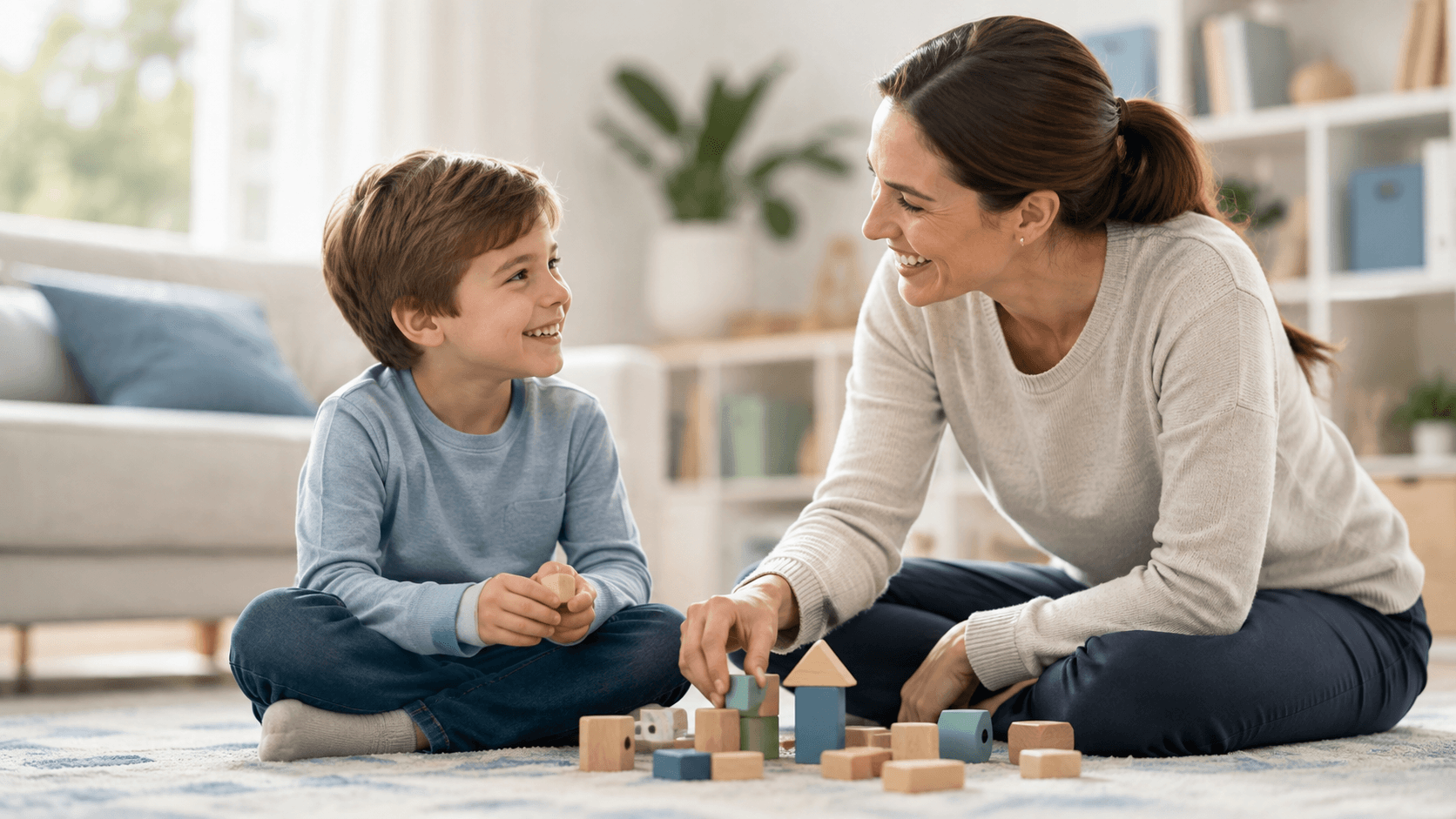
We’ll take the time to connect with your child through the activities they love.
Legos. Woodworking. Chess. Cars. Music. Whatever sparks their interest, we’ll join in their fun and follow their lead, so they feel in control of their environment and connected with their therapist.
3
Cultivating true understanding
Once your child feels safe and connected, we’ll begin treatment by introducing gentle cognitive challenges.
For example, a child who struggles with transitions may simply lack the ability to plan ahead. Instead of forcing the switch, we ask during the current activity: “After this, what will we do next?” Over time, the child begins to internalize that process on their own — growing from the inside out, not just copying behaviors expected of them.
4
Achieving independent changes throughout day-to-day life
We don’t measure success by how well a child performs in a session. Rather, we measure how well they’re applying their learning to new situations, without anyone else prompting them.
A child can’t be taught the correct behaviors for every scenario. They need to understand how their behaviors actually affect the world. For example, a child who understands that people don’t like to be ignored will naturally respond to greetings — not because a therapist reminded him, but because he gets why it matters.
The question we’ll always ask at Real Change ABA is: are we creating a child who will always depend on someone else to guide their behavior — or are we creating a child who is motivated to change from within?
How progress shows up in real life
Expressing Needs
Holding Conversations
Making Friends
Getting Along With Others
Self-Perception and Self-Esteem
Repetitive Behaviors
Tantrums and Meltdowns
Difficulty at Home
Behavior in School
Behavior in Public
Academics
Getting Along with Siblings
Listening to Parents
Where we’ll meet
At home
For most children and families, home is the best place for us to meet.
It’s where your child is most comfortable and where we can observe how they behave in a familiar environment.
In school
Many of your child’s challenges may show up most at school.
We work closely with teachers and staff to make sure your child has the support they need in the classroom.
Standard ABA vs. Real Change ABA
| Standard ABA | Real Change ABA |
|---|---|
| Focused on observable, measurable behavior | Focused on the child’s thinking and understanding |
| Therapist drives the agenda | Therapist follows the child’s lead |
| Child is the subject of change | Child buys into the process and wants to change |
| Relies on external management and rewards | Relies on child internalizing an understanding of behavior, rather than mimicking correct behavior |
| Measures behavior in controlled environments | Measures what parents actually see at home, in school, and with friends |
| Goal is behavior compliance | Goal is true understanding and perspective |
| Improvements are context-specific | Improvements are holistic, driven from the inside |
Children who’ve experienced Real Change
Names changed to protect privacy
Danny, Age 10 — The Child Who Lived in a Puzzling World
The Child: Danny’s first sentence to us was a joyful: “Joey Newcomb sang at the wedding!” He gave no further context, and that statement had in no way connected to anything we’d been discussing.
This proved to be the first of many such bursts of conversation. Danny was a fountain of endless questions: “How far is California?” “How much does your car cost?” “What are those road workers fixing?” But before we could finish answering one question, he’d already moved to the next.
His father had tried tutors for years but Danny still read at a first-grade level. Teachers found him exhausting. Simple conversations proved impossible.
Read full story →
The Challenge: By getting to know Danny, we discovered he wasn’t actually curious. He was anxious. He was living in a world that felt random and unpredictable to him, and questions were simply his way of trying to map it all out. Answering or explaining the details with him didn’t resolve his issues because his mind couldn’t make use of abstract information. He needed to experience understanding, not receive it.
The Change: Our treatment plan started with neighborhood excursions. On our first outing, we took him to a grocery store. He spotted a woman near the back playing with her child and asked, baffled: “Why does she think this is a playground?” We talked through the possibilities together. “Maybe she’s waiting for her husband,” we suggested. “Maybe,” Danny answered, “but maybe she’s divorced?” We discussed our thoughts until the woman’s husband arrived a few minutes later. Seeing him, Danny grew visibly calmer.
Session by session, his questions have slowed. He has begun to master the art of natural conversation, with its give and take.
His father said it best: “I thought he needed more information. But what he actually needed was a different way of thinking.”
Eli, Age 7 — The Child Who Needed Control
The Child: Eli was the opposite of flexible. He needed his world to be completely predictable. His route home every day needed to follow the same streets and stops, or Eli would grow overwhelmed. In fact, any deviation from routine or expectations became a crisis.
Read full story →
The Challenge: All previous behavioral approaches had tried to push him toward flexibility. But that only proved to make him more rigid. The more he was pressured, the more he shut down.
The Change: Instead of continuing to push Eli, we created low-grade friction for him to overcome in a fun environment. We started with his favorite card game. Eli had an exact way he liked to mix cards and would get upset if anyone did it differently. So instead of asking him to change it, we complimented his method then gently challenged him: “Is this the only way to mix them? What if someone is in a rush?” Giving him that moment to pause and reflect was the beginning of Eli’s “Real Change.” We expanded how he thought, not correcting a specific behavior.
Slowly, we introduced more low-pressure suggestions — things like trying a new flavor, or taking a new route home to see a new traffic light. Slowly, Eli became more and more open to trying new things.
And as his thoughts expanded, his worldview did too — and his rigidity improved right alongside that.
Sam, Age 10 — The Boy Who Couldn’t See Others
The Child: When we first met with Sam, he was smart, energetic, and entirely hopeless at making friends. He constantly found himself fighting with other kids, grabbed their belongings, and retaliated at the slightest provocation. He felt isolated and had no real friends, and no idea why.
Read full story →
The Challenge: Previous therapists had tried explaining, correcting, and giving consequences. But Sam struggled to connect his actions to other people’s feelings. He genuinely couldn’t see others as people with feelings worth considering.
The Change: We started with woodworking — something Sam loved. Together we built a bookcase for his classroom. When it was nearly finished, he announced he was keeping it for himself. Rather than correcting him, we used the moment to reflect back to him what his decision hadn’t accounted for: that we were the ones who had bought the wood, that we also deserved a say, and that our feelings mattered too.
It was difficult for Sam, but slowly, after several sessions, because he felt considered and safe, he was able to acknowledge our perspective.
His teacher noticed the change before we even mentioned it. Sam had begun pausing before “retaliating” in class. He was developing into a person who could and would consider another person.